
A beautiful puzzle deserves better than a precarious corner of the dining table. The best jigsaw storage solutions protect your work in progress from curious pets, busy family life and the classic missing-piece mystery, while making it easy to return to puzzling when you have a spare half-hour.
For serious puzzlers, storage is not only about tidiness. It is about keeping sections intact, sorting pieces faster and knowing a nearly finished artwork will still look just as satisfying tomorrow. The right choice depends on your puzzle size, your available space and whether your completed puzzle is headed for a frame, a shelf or a new home as décor.
Best Jigsaw Storage Solutions for Every Puzzle Stage
A puzzle in progress needs a different setup from a finished display piece. Start by thinking about where your puzzle sits most often: on a shared table, in a dedicated hobby nook or on a coffee table that needs to be cleared by dinner time.
Puzzle boards with a carry case
A purpose-made puzzle board is one of the most practical options for works in progress. It gives pieces a firm, flat surface and many styles come with a cover, zip case or carrying handles. When you need the table back, simply cover the puzzle and slide it under a bed, behind a sofa or into a wardrobe.
Choose a board that is larger than your finished puzzle dimensions, not just the box size. You need enough spare room around the edge for sorting and building border pieces. A board with a non-slip or felt-style surface can also help loose pieces stay put while you move it.
The trade-off is storage space. Large boards are brilliant for 1,000-piece puzzles, but they can be awkward in compact flats. If space is tight, a roll-up mat or a foldable board may suit better.
Roll-up puzzle mats
Roll-up mats are made for puzzlers who need flexibility. Build directly on the felt surface, place the inflatable tube at one end, roll carefully and secure it with straps. Your puzzle can then be tucked away in a cupboard until the next session.
They are compact and budget-friendly, especially for occasional puzzlers. However, rolling is not ideal for every puzzle. Loose sections can shift if the mat is rolled too quickly or without enough tension, and very detailed builds may take a little time to settle flat again. Use a mat for early and middle stages, then switch to a firm board when you are working on delicate, almost-complete sections.
Puzzle sorting trays and stackable organisers
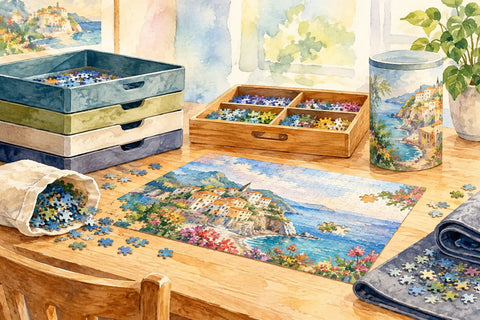
The fastest way to make a large puzzle feel manageable is to sort before you start. Small trays let you separate edge pieces, strong colours, recognisable objects and those tricky all-blue-sky sections. Stackable trays are particularly useful because they keep categories protected without taking over the table.
Look for shallow trays with lids if children, cats or breezy rooms are part of the equation. Clear containers make it easier to see what is inside, while opaque trays can reduce visual clutter if your puzzle corner is in a living space. You do not need a complicated system either. Four to six trays are usually enough to keep a standard puzzle session organised.
Portable puzzle cases
A portable case is a smart middle ground between a board and a full hobby station. These cases often include a folding surface, zip closure and compartments or drawers for loose pieces. They suit anyone who puzzles at the kitchen table, takes projects to a bach or wants to keep a puzzle safely contained between visits from the grandkids.
Check the interior size before buying. Some cases comfortably hold smaller puzzles but will not fit a 1,000-piece landscape with room around the outside. Also consider the case weight once it is loaded. A portable option should be easy to carry, not an awkward balancing act from room to room.
Large flat storage under furniture
Sometimes the simplest solution is the one already in your home. A rigid foam board, lightweight drawing board or flat tray can turn any table into a temporary puzzle space. Once you are finished for the day, cover the puzzle with another board or clean sheet of card and slide it under a bed or couch.
This approach works best when the puzzle is built on a stable, rigid base. Avoid thin cardboard that bends, particularly with heavier pieces or a large completed border. It is an affordable setup, but it offers less protection from moisture, bumps and accidental bending than a dedicated case.
Choosing Storage by Puzzle Type
Not all puzzles behave the same way. Traditional cardboard pieces can lift, bend and separate when moved, so they need a little extra care. Premium plastic puzzles offer a different kind of freedom: quality interlocking pieces can hold together firmly, making it much easier to lift a completed section or move the entire finished image onto a display surface.
That does not mean every plastic puzzle should be stored carelessly. Keep completed puzzles flat when possible, especially before framing, and avoid placing heavy items on top. Water-resistant pieces are wonderfully practical for everyday life, but a dry, clean storage spot is still the best way to preserve the box, artwork and overall presentation.
For a finished Pintoo-style or PieceRelax® puzzle, storage can become part of your display plan. Because the pieces connect securely and no glue is needed, you can complete the image, move it with care and choose whether it belongs in a frame, on a shelf or as part of a rotating wall display. That is a major advantage over a puzzle that must be packed away as soon as it is done.
A Simple Setup That Keeps Puzzles Enjoyable
The best system is the one you will actually use. For most homes, a large board or puzzle case paired with sorting trays gives you the right balance of protection and convenience. Keep the puzzle box nearby for reference, but take a quick photo of the image on your mobile too. It is handy when the box is under a pile of trays or in another room.
Store loose pieces in lidded trays at the end of each session, especially if you are not using a covered board. Keep drinks on a separate surface where possible. Even water-resistant puzzle pieces deserve better than a mug ring beside the last piece of a detailed floral scene.
If you puzzle with children, give each project its own labelled container. It prevents pieces from different puzzles mixing together and makes pack-up feel like part of the activity rather than a chore. For collectors, label storage by piece count, design or collection so it is easy to find the right project when the mood strikes.
When Your Puzzle Is Ready to Be Seen
Finished puzzles do not have to disappear into a box. If you have spent evenings building a striking cityscape, artwork or favourite character design, give it a proper place in your home. A frame protects the surface from dust and makes the colours feel intentional, while a puzzle display shelf lets you rotate completed designs with the season.
Before framing, make sure the puzzle is clean and fully flat. Measure the completed image, rather than guessing from the box, and choose a frame that supports it evenly. Plastic interlocking puzzles are especially satisfying here because they can stay together without glue, giving you a clean, display-ready finish.
At Puzzle Art Store, that is part of the joy: a premium puzzle can begin as a relaxing project and end as a collectible piece of art. Choose storage that protects the making process, then let the finished design earn its spot on the wall.
Comments (0)
There are no comments for this article. Be the first one to leave a message!